
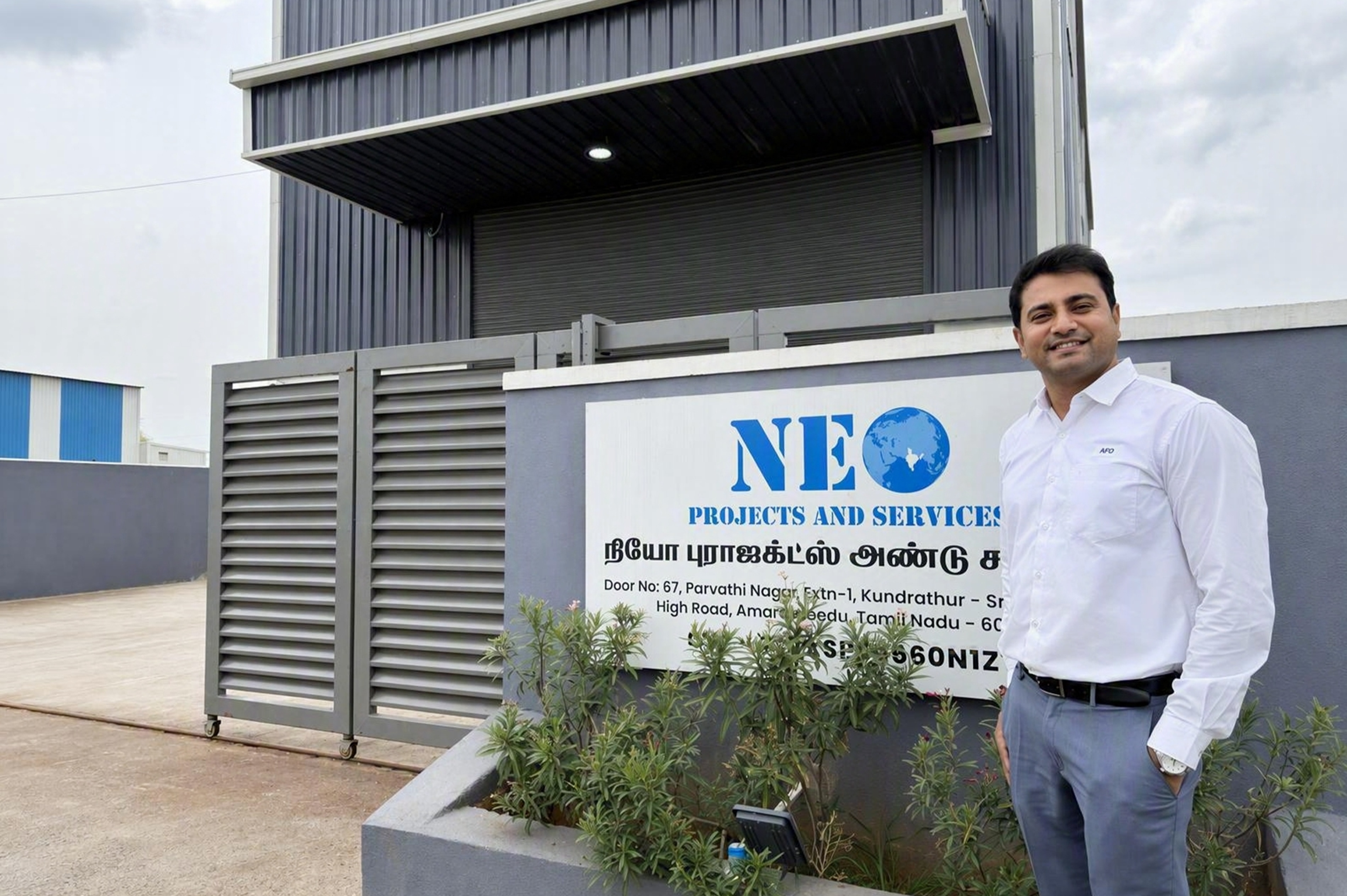
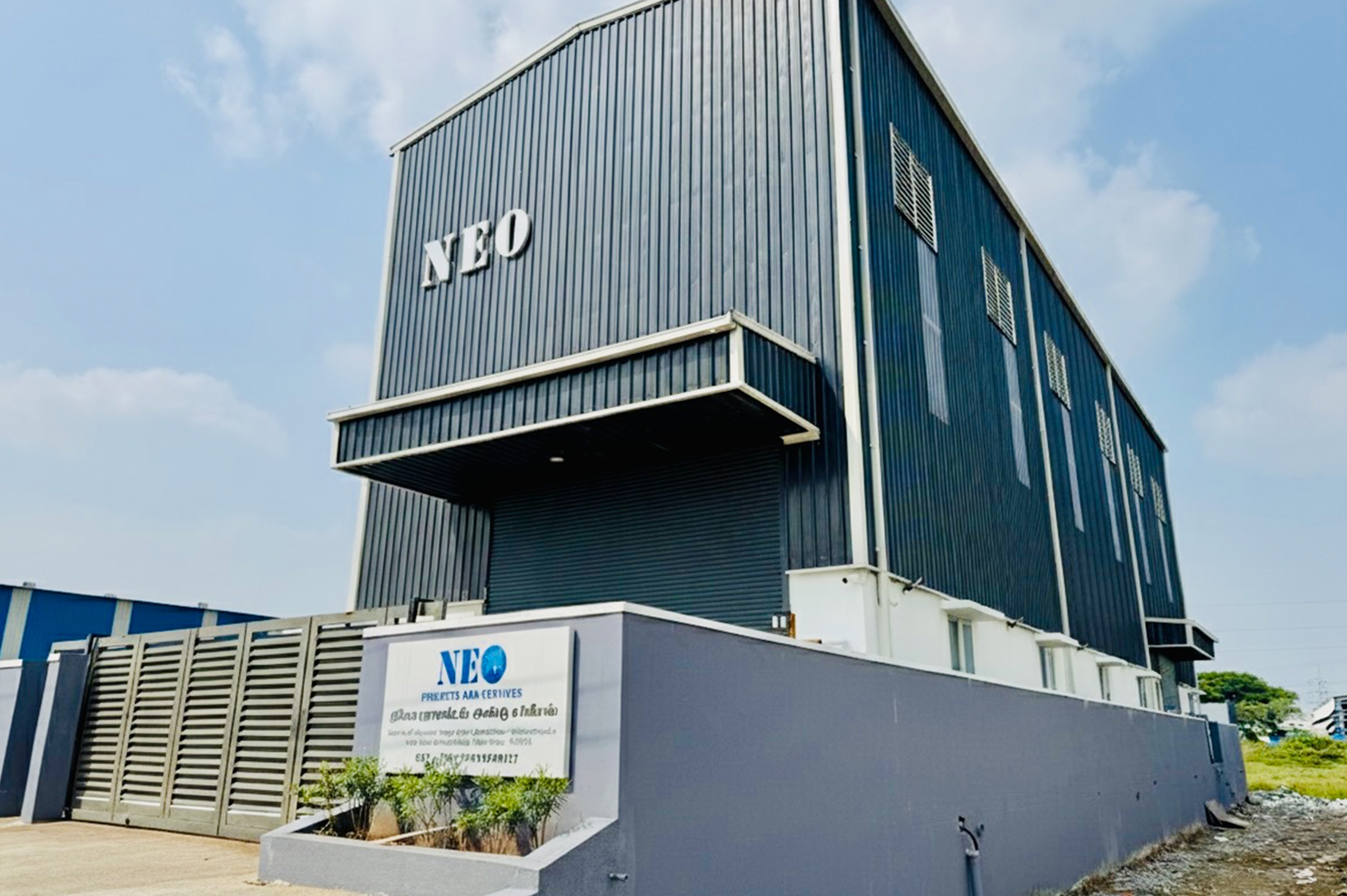
NEO Projects and Services builds the machines that other manufacturers depend on. Founded in 2019 and based in Sriperumbudur, Chennai, the company delivers special purpose machines, laser marking systems and robot automation to automotive and electrical / electronic component makers. For founder Soundararajan Mahalingam, the measure of a good machine is simple: once it is installed, his team should not have to go back. That standard is why he selects on reliability and repeatability rather than on specification alone — and why the KEYENCE LJ-S Series ended up in a flatness inspection station where the part can be neither clamped nor moved.
Summary
- NEO Projects and Services (Sriperumbudur, Chennai, founded 2019) builds special purpose machines, laser marking systems and robot automation for automotive and electronic component manufacturers.
- Other make sensor and vision equipment used on earlier projects proved insufficiently user-friendly and unreliable for the applications the team was taking on.
- The KEYENCE LJ-S Series is selected where the part cannot be clamped or traversed — it is rested on support points, scanned and removed, within a tight station cycle time.
- A KEYENCE laser marker made possible a difficult marking application on a non-flat plastic surface that the team describes as one of its toughest projects.
- Because devices such as the IV4 Series do not need re-teaching or repeat demonstrations after installation, NEO avoids return service visits and cuts the associated cost.
- Separate sales and technical functions, with direct access to both, mean responsibility for a delivered solution is shared rather than passed along a chain of intermediaries.
ChallengeWhat was not working with the previous equipment?
Mr. Soundarajan Mahalingam began his career in 2005 and has worked across a wide range of machine types, using a variety of sensing and vision equipment along the way. On ordinary applications, most of it was serviceable. The problems appeared on the projects that mattered most — the ones where the customer's requirement was genuinely hard.
On those applications the equipment was not user-friendly enough for his engineers, and it did not reach the quality or performance the application demanded. Summarising the issue, he reduces it to one word.
"Reliability. In other words, you can say quality and reliability was not good."
For a machine builder, that is not an inconvenience but a commercial risk. NEO does not manufacture parts; it supplies the equipment its customers use to manufacture theirs. Its stated objective is that a not-OK part must never reach the end user — an OK part occasionally judged NG is tolerable, the reverse is not. An unreliable sensing device puts that promise directly at risk.
SelectionWhat does a machine builder actually select on?
Asked what he looks for, Mr. Soundarajan Mahalingam gives three criteria in order. The first is supportability — he wants to be able to reach the supplier, and any team inside it, without friction. The second is product reliability: repeatability and consistent quality across all operating conditions. The third is reliability over time, which he is careful to distinguish from the second.
"It is not like one time I purchased and it's working for one year, and the second year it goes down. The repeatability on your products from day one till it works, it's good."
Support turns out to be more than a comfort factor. In his experience with suppliers generally, the salesperson who runs the demonstration and the trials is not necessarily the person whose priorities remain aligned once the equipment reaches the field. He values the fact that KEYENCE separates the two functions, so a technical team handles implementation. Equally important is that neither company hides behind the other.
"When there is a problem, I can directly go and ask the team. Whatever happens, we need to mutually discuss, share our responsibilities and give the right solution to the customer. Whenever a customer asks me 'Why KEYENCE?', this is my first answer: If KEYENCE and NEO are involved, we will take complete responsibility, no matter what happens."
EffectWhere does the LJ-S Series earn its place in a machine?
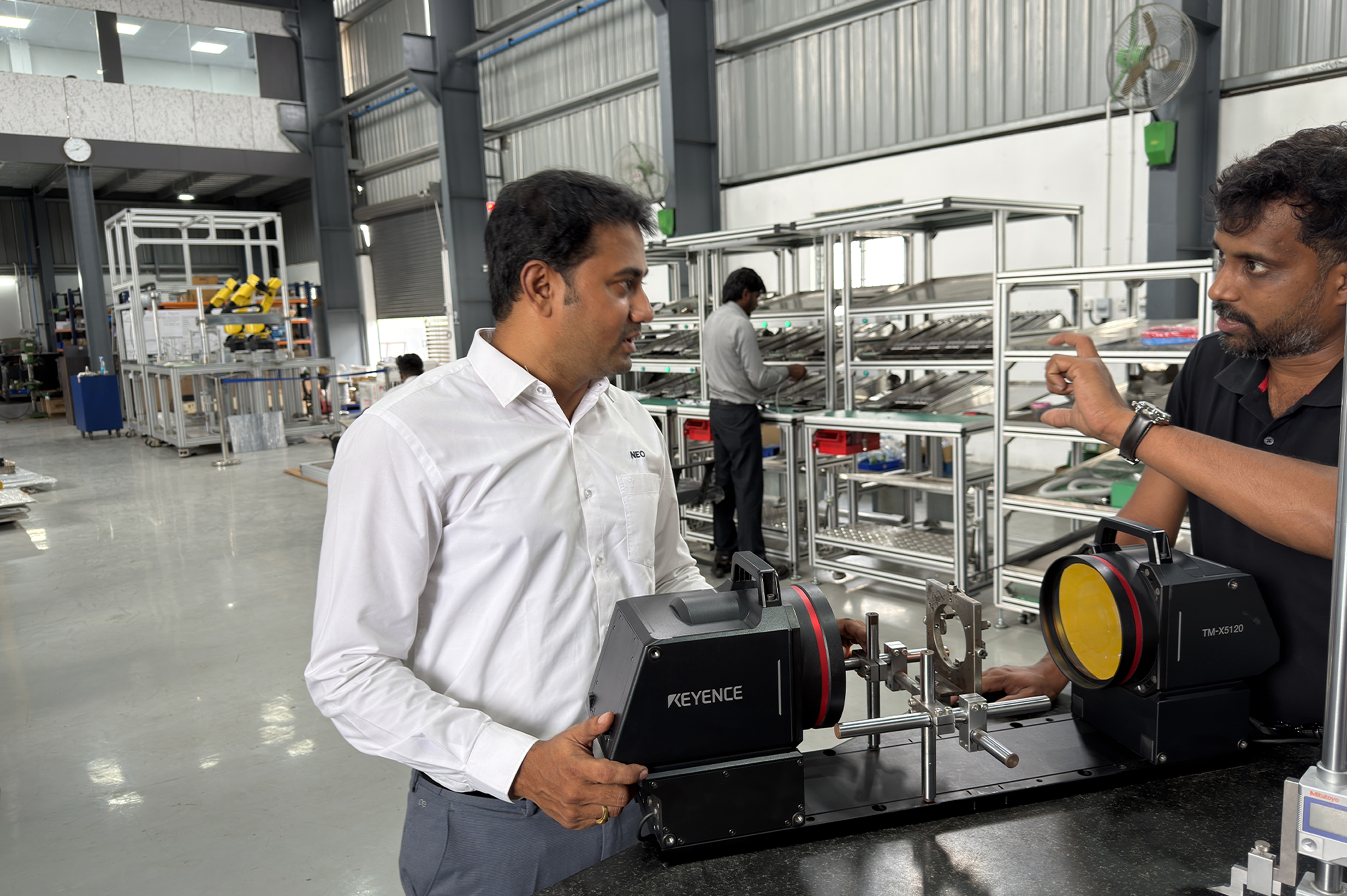
The clearest illustration is a flatness inspection application on plate material. The constraint that drove the design was mechanical, not optical: the part could not be clamped, and it could not be moved. It is simply rested on support points, scanned, and removed — and the station has a tight cycle time to hold.
That combination rules out the conventional approach of traversing a profile sensor across the part with a moving axis. Because the LJ-S Series captures the three-dimensional shape without the part or the head having to travel, a single trigger produces the measurement. Mr. Soundarajan Mahalingam is precise about when this matters, and equally precise about when it does not.
"Whenever we cannot clamp the part, wherever we cannot move the part, And where cycle time we have issues, we can use this. But when you have cycle time, when you have space, when you can move the part, you can go for LJ-X."
A second application shows the same pattern of matching the device to a hard constraint. A customer needed marking on a surface that was not flat, in plastic — a combination the team calls one of its most challenging laser marking projects. It was delivered successfully with a KEYENCE laser marker head.
Beyond the individual applications, the benefit Mr. Soundarajan Mahalingam did not anticipate is one that shows up in his own cost structure. His agenda when selling a machine is that he should not have to go back for service. With KEYENCE devices — a standard sensor, or an IV4 Series vision sensor — that holds: no engineer has to return to re-teach the system or repeat a demonstration after installation.
"When I provide a KEYENCE product, there is no need for additional training visits or repeat demonstrations. This eliminates extra service costs and helps reduce overall operating expenses."
OutlookWhat is next for the business?
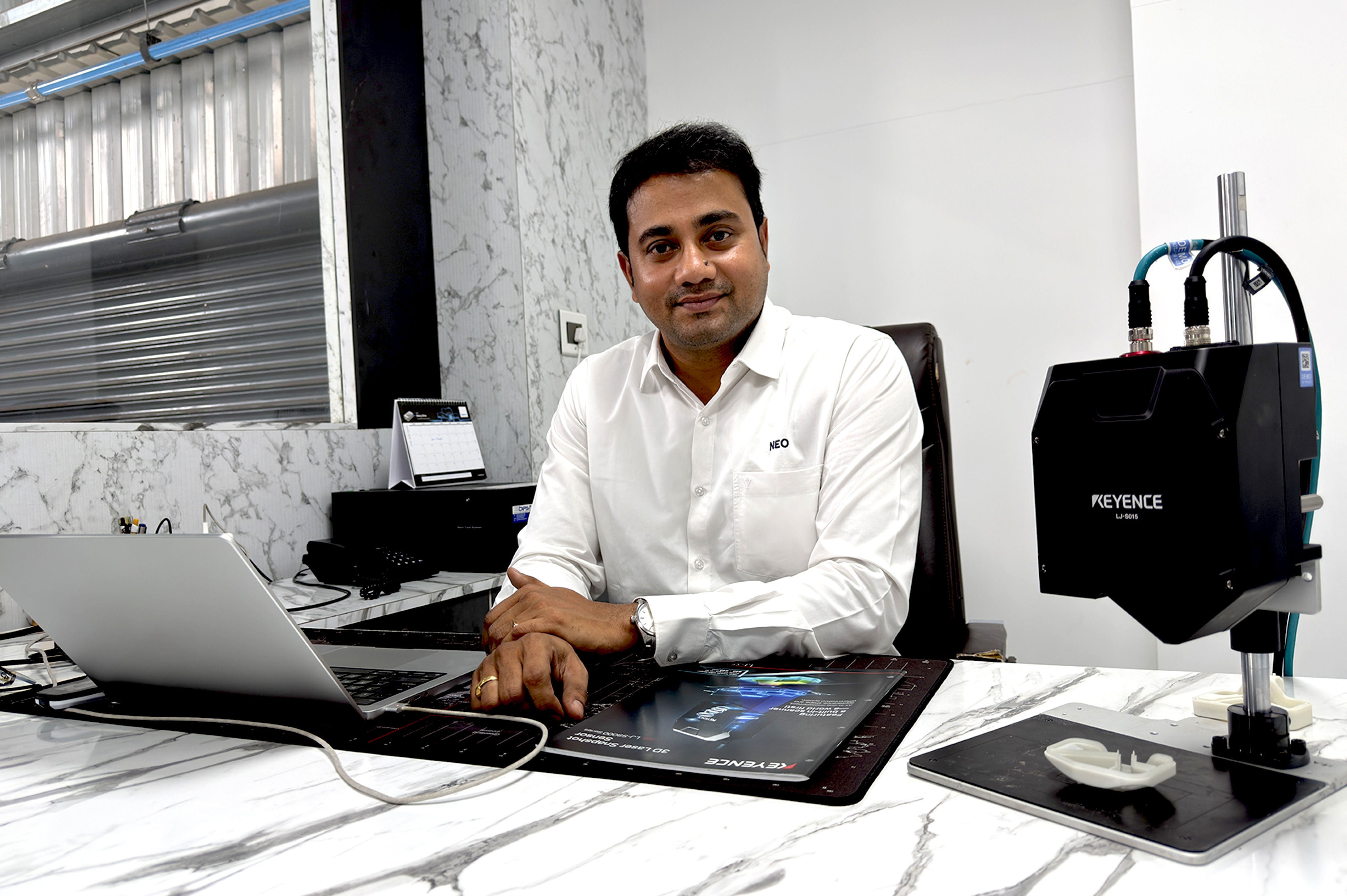
NEO's next area of growth is the electronics sector. Alongside its established automotive work, the team is developing laser marking machines for printed circuit board and surface-mount applications, and is planning a complete package — the marking machine together with the associated handling system, enabling customers to evaluate and implement a fully integrated solution rather than building one from individual components. This solution is also applicable to semiconductor industry applications.
Asked whether KEYENCE would remain a partner as the business expands, the answer is a straightforward "YES". The reason he gives is the one he returns to throughout the interview: the working relationship runs in both directions, and neither side redirects the customer to the other.
"It's not like, if I take an order, KEYENCE will say 'talk to NEO'. Or if I take a project, I will never say 'talk to KEYENCE'. We are always merged."
Frequently asked questions
Q What was NEO Projects and Services using before it standardised on KEYENCE?
A
The team had worked with a range of other sensor and vision equipment across different machine projects. On certain applications those products proved not to be user-friendly enough and did not deliver the quality or performance the team needed. Reliability was the core issue.
Q What does the company look for when selecting a supplier such as KEYENCE?
A
Three things. First, supportability — being able to reach the supplier and any of its teams easily. Second, product reliability, meaning repeatability and consistent quality under all conditions. Third, long-term repeatability: a device that performs from day one and does not degrade in its second year.
Q In what situations does the team choose the KEYENCE LJ-S Series?
A
The LJ-S Series is chosen when the part cannot be clamped and cannot be moved. In one flatness application the part simply rests on support points, is scanned and is removed, with no clamping at all, and the station has a tight cycle time. Where the part can be traversed and cycle time allows it, the team still uses a profile-scanning approach with a moving axis instead.
Q What kind of laser marking application did KEYENCE make possible?
A
One customer had a demanding marking requirement: the surface was not flat and the material was plastic. The team took on the project and delivered it successfully with a KEYENCE laser marker head, which they describe as one of their most challenging laser marking projects.
Q How did KEYENCE products affect service and support costs for the machines NEO delivers?
A
The stated goal is to deliver a machine that does not require the team to return. With KEYENCE devices such as the IV4 Series vision sensor or a standard sensor, there is no need to send an engineer back to re-teach the system or repeat the demonstration after installation, so service cost is reduced.
Q Why does NEO Projects and Services recommend KEYENCE to other manufacturers?
A
Because responsibility is shared. Sales and technical support are separate functions, so after the sale a technical team handles implementation rather than the salesperson. There are no intermediaries to pass the problem between, and when an issue arises both companies discuss it and take joint responsibility for the solution delivered to the end customer.